Drone Inspections for Roof Assessments: How Defects Are Identified Quickly and Safely
Roofs are one of the most critical—and most commonly overlooked—parts of a building. Defects can lead to water ingress, internal damage, safety hazards, and costly repairs if not identified early.
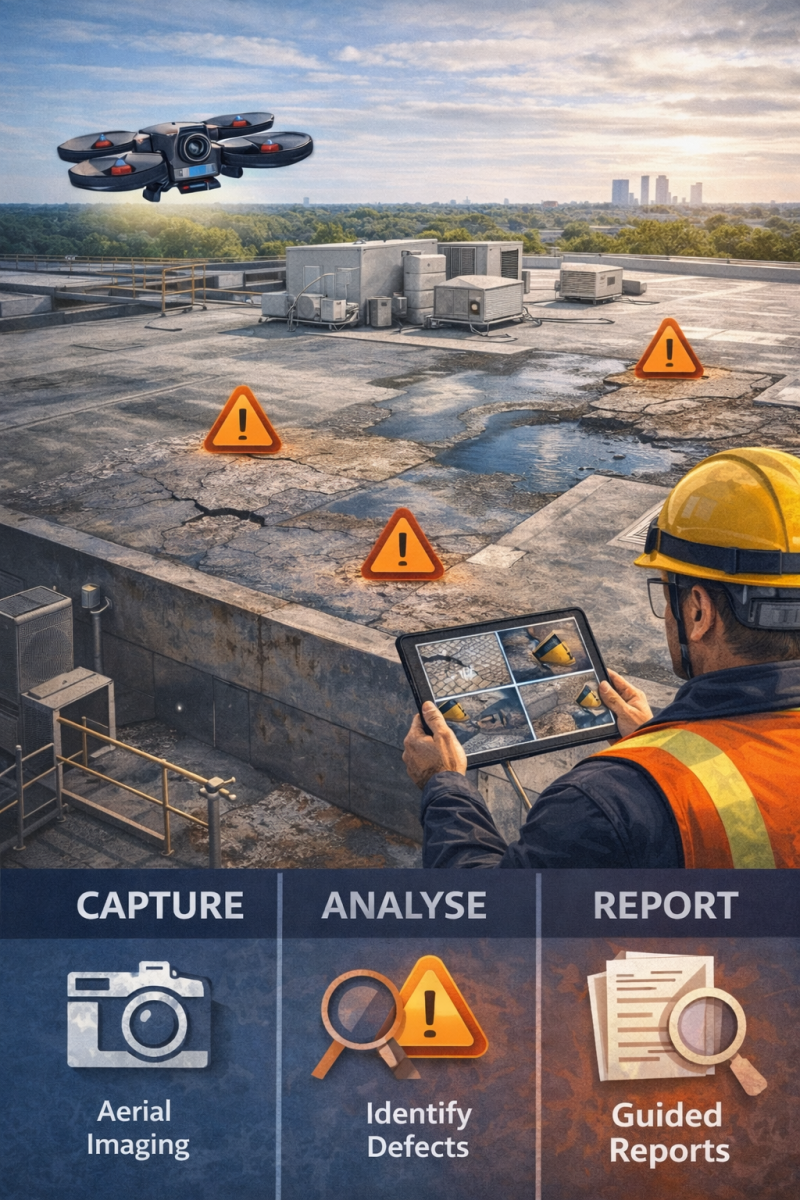
Drone inspections provide a safe and efficient way to assess roof condition, particularly on large commercial and industrial buildings where traditional access is time-consuming, disruptive, or hazardous.
This article explains how drone roof inspections work, what defects they can identify, and where they add the most value.
Why Roof Inspections Are Challenging
Traditional roof inspections often involve:
-
Working at height
-
Fragile roof materials
-
Temporary access systems (MEWPs or scaffolding)
-
Restricted access to certain areas
These factors increase risk and can make routine inspections costly or difficult to justify—especially when the inspection objective is primarily visual.
How Drone Roof Inspections Work
1. Planning and Assessment
Every roof inspection starts with understanding:
-
Roof type (flat, pitched, metal, membrane, etc.)
-
Access points and hazards
-
Inspection objectives
-
Site constraints and surroundings
This ensures the inspection method is appropriate and safe.
2. Aerial Visual Inspection
High-resolution imagery and video are captured across the roof surface, focusing on:
-
General condition
-
Known problem areas
-
Edges, penetrations, and transitions
-
Areas difficult to access from ground level
Drones allow close-up inspection without placing personnel on the roof.
3. Review and Reporting
Captured imagery is reviewed to identify:
-
Defects or deterioration
-
Areas of concern requiring closer investigation
-
Locations suitable for targeted access or repair
Findings can be presented through annotated imagery, video, or structured reports depending on requirements.
Common Roof Defects Identified by Drones
Drone roof inspections are particularly effective at identifying:
-
Cracks, splits, or tears in membranes
-
Standing water and drainage issues
-
Damaged flashing or edge details
-
Loose or missing fixings
-
Impact or weather-related damage
-
Deterioration around plant and penetrations
While drones cannot replace physical testing, they are highly effective at highlighting where further investigation may be required.
Safety Benefits of Drone Roof Inspections
One of the key advantages of drone inspections is risk reduction.
They can:
-
Reduce or eliminate the need for working at height
-
Avoid walking on fragile or deteriorated roofs
-
Minimise time spent in hazardous areas
-
Reduce disruption to building occupants or operations
This makes drone inspections particularly valuable for large or operational sites.
When Drone Roof Inspections Add the Most Value
Drone roof inspections are most effective when:
-
The inspection objective is visual condition assessment
-
The roof area is large or complex
-
Access is hazardous or limited
-
A rapid overview is required to inform next steps
They are often used as a first-stage inspection, helping asset owners and engineers decide whether further access or remedial work is required.
Limitations to Be Aware Of
Drone roof inspections are visual-only and cannot:
-
Perform physical testing
-
Assess subsurface conditions
-
Replace intrusive inspections where required
For this reason, they are best used as part of a staged inspection strategy, rather than as a standalone solution for all scenarios.
Conclusion
Drone inspections offer a safe, efficient, and cost-effective way to assess roof condition—particularly on commercial and industrial buildings.
By providing clear visual information without the risks associated with traditional access methods, drone roof inspections help asset owners:
-
Identify defects early
-
Reduce unnecessary access
-
Plan targeted maintenance or repairs
Used appropriately, they are a valuable tool in modern building inspection and asset management.




Add comment
Comments